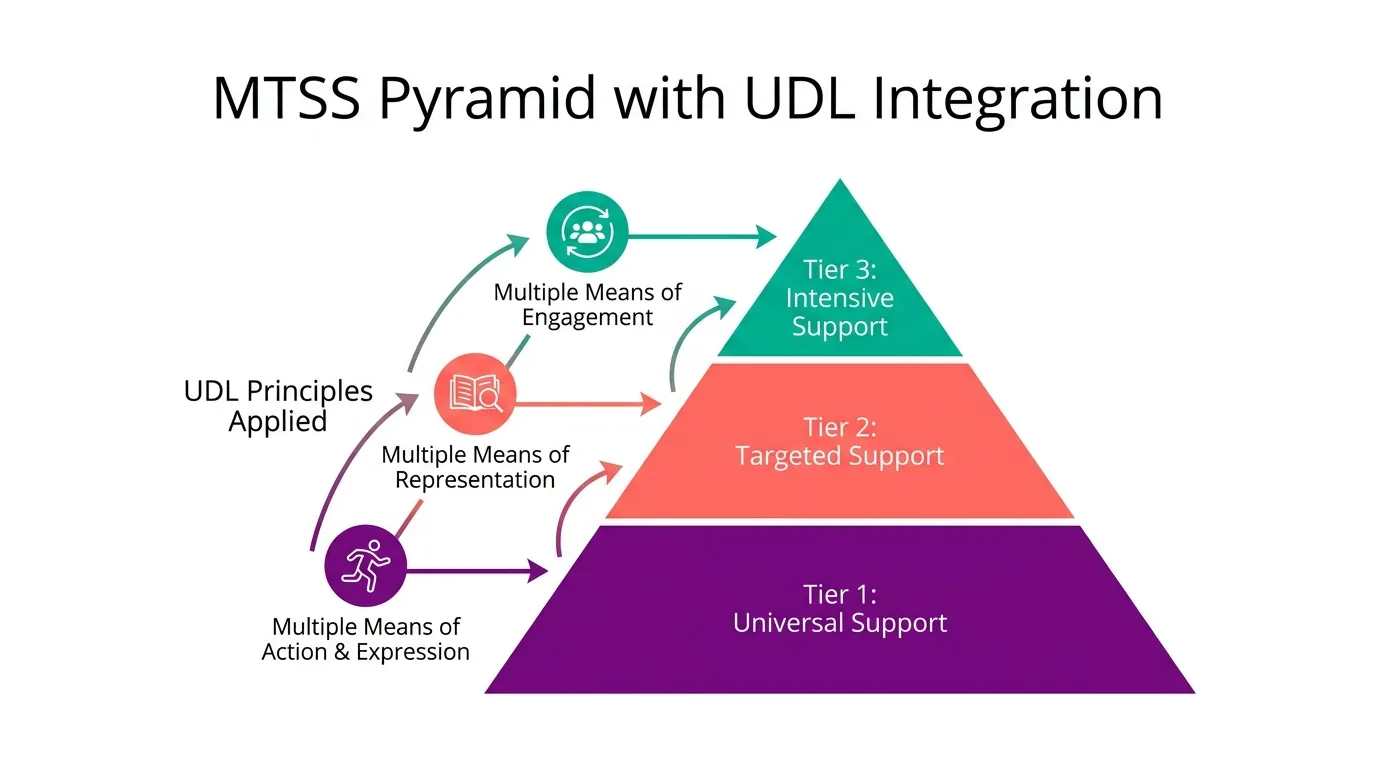


Comment la CUA et le MTSS fonctionnent ensemble (guide pour les écoles K-12)
La CUA structure l'enseignement du niveau 1. Le MTSS ajoute les soutiens des niveaux 2 et 3. Ensemble, ils réduisent les orientations inutiles et libèrent la capacité pour les élèves qui ont besoin d'une véritable intervention.




UDL and MTSS are two of the most widely adopted frameworks in US K-12 schools, and they are designed to work together. UDL (Universal Design for Learning) shapes how teachers design Tier 1 instruction so every student can access core content. MTSS (Multi-Tiered System of Supports) layers targeted interventions on top of Tier 1 for students who need more. The connection between UDL and MTSS is simple: strong UDL reduces the number of students who need Tier 2 or 3 interventions. Roughly 15 percent of US students receive special education services (NCES), and unnecessary referrals to Tier 2 and 3 are a real cost - human and financial - that strong Tier 1 instruction prevents.
How UDL and MTSS Fit Together
UDL is the instructional design layer. MTSS is the support structure layer. UDL applies to Tier 1 - the core instruction every student receives - and makes that instruction flexible enough that fewer students fall through. MTSS adds Tier 2 (targeted small-group support) and Tier 3 (intensive individualised support) for students whose needs are not met at Tier 1. Without strong UDL at Tier 1, schools tend to over-refer students into Tier 2 and 3 because the universal level is not actually universal.
UDL at Tier 1: Designing the Universal Level
Tier 1 is where UDL does the most work. CAST's UDL framework gives teachers three principles to apply at Tier 1:
- Engagement - offer choice and connect content to student interests so motivation does not depend on willpower alone
- Representation - present the same content through text, audio, visuals, and demonstration so students do not depend on a single modality
- Action and Expression - let students respond through writing, voice, video, or diagrams - all assessed against the same rubric
When Tier 1 instruction is designed this way, the students who would have needed pull-out support to access the reading can stay in the classroom - because the audio version is available to everyone, not flagged as an accommodation.
MTSS at Tier 2 and 3: When UDL Is Not Enough
Strong UDL at Tier 1 will not catch every student. Some learners need more targeted instruction - more time, smaller groups, more explicit teaching. That is where MTSS Tier 2 and 3 come in. The role of UDL within Tier 2 and 3 is still active: the supports delivered in a small reading group, for example, should still offer multiple modalities and multiple ways for students to respond. UDL principles do not turn off at Tier 1.
Why Schools Pair UDL and MTSS
Schools that pair UDL and MTSS see two main benefits:
- Fewer unnecessary referrals. When Tier 1 is genuinely accessible, fewer students get flagged as needing Tier 2 simply because of how the lesson was delivered.
- Faster, more focused intervention. When a student does need Tier 2 or 3, the team has high-confidence data that the issue is not the delivery method - because the delivery was already flexible.
The federal Every Student Succeeds Act names both UDL and MTSS as recommended frameworks - and increasingly, state departments of education require schools to address both in their improvement plans.
Common Mistakes When Combining UDL and MTSS
Three mistakes show up repeatedly when schools try to combine UDL and MTSS:
- Treating UDL as a Tier 1 box to tick. UDL is a design lens, not a worksheet. It needs to live in lesson plans, not in a binder.
- Using MTSS data without UDL context. If 40 percent of students need Tier 2 reading, the issue is more likely Tier 1 design than a sudden surge in reading disabilities.
- Reserving tools for Tier 2 students. Text-to-speech and speech-to-text belong in Tier 1 for everyone, not as labelled accommodations for some.
Where Mote Fits
Mote was built to make UDL feasible at the Tier 1 level. Read Aloud, multilingual dictionary, voice notes, and speech-to-text are all available to every student in the class - not labelled, not flagged, not gated. That keeps the tools where UDL says they belong: in Tier 1, for everyone. See our complete guide to Universal Design for Learning for the framework that ties UDL and MTSS together.
The bottom line: UDL is the engine that makes MTSS work. Strong UDL at Tier 1 reduces unnecessary referrals to Tier 2 and 3, and frees up intervention capacity for the students who really need it.