



MTSS Reading Interventions: A Tier-by-Tier Guide for 2026
Evidence-based reading interventions for Tier 1, 2, and 3, with the assistive technology tools that make each work in real classrooms.




MTSS reading interventions only work when the intervention matches the tier. Strong Tier 1 reading instruction reaches every student. Targeted Tier 2 supports the 10 to 15% who need more. Intensive Tier 3 catches the 1 to 5% with the deepest needs. The science of reading tells us what works at each level. The MTSS framework tells us how to deliver it. This guide brings them together.
The MTSS Reading Intervention Model in 2026
An MTSS reading intervention is an evidence-based reading practice delivered at one of three tiers based on student data. Tier 1 is universal core reading instruction for all students. Tier 2 is supplemental small-group reading support for students who need more. Tier 3 is intensive, individualized reading intervention for students with the most significant needs.
The proportions hold across reading specifically:
- Tier 1: 80 to 90% of students reach grade-level reading with strong core instruction alone.
- Tier 2: 10 to 15% need supplemental small-group support to keep pace.
- Tier 3: 1 to 5% need intensive individualized intervention, often connected to a documented reading disability such as dyslexia.
For background on the framework, see our guide to MTSS tiers and MTSS vs RTI comparison.
Tier 1 Reading Interventions: Universal Core Instruction
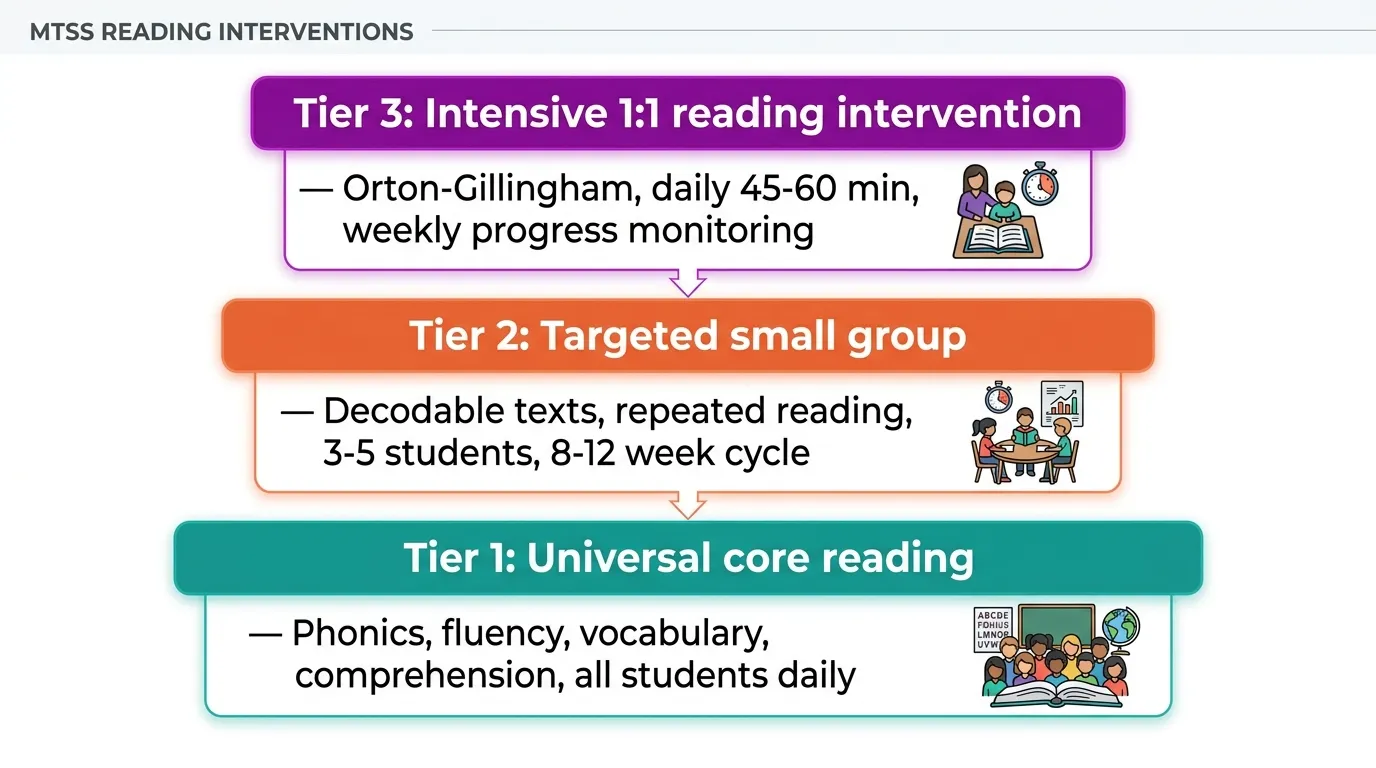
Tier 1 is high-quality core reading instruction delivered to every student. The strongest Tier 1 programs are aligned to the science of reading and explicitly teach the five pillars identified by the National Reading Panel: phonemic awareness, phonics, fluency, vocabulary, and comprehension.
Effective Tier 1 reading practices:
- Daily explicit phonics and decoding instruction in K-3 grades
- Fluency modeling through shared reading and read-alouds
- Direct vocabulary instruction in academic content
- Comprehension strategies taught and practiced across subjects
- Universal accessibility supports such as text-to-speech, visual aids, and translation available to all students
The What Works Clearinghouse reviews Tier 1 reading programs for evidence quality. Schools with strong Tier 1 see fewer students needing Tier 2 or 3 over time.
Tier 2 Reading Interventions: Targeted Small-Group Support
Tier 2 reading interventions are supplemental, evidence-based supports delivered to small groups of 3 to 5 students for 30 to 45 minutes, three to five times per week, over an 8 to 12 week cycle.
Common Tier 2 reading interventions:
- Decodable text small-group instruction for early readers
- Repeated reading and partner reading for fluency
- Structured comprehension routines (POSSE, reciprocal teaching)
- Vocabulary intensification using academic word lists
- Phonological awareness practice for K-2 students with weak foundations
Tier 2 should supplement Tier 1, never replace it. Students in Tier 2 still receive full core reading instruction; the intervention is additional time and intensity, not a different track.
Tier 3 Reading Interventions: Intensive Individualized Support
Tier 3 reading interventions are the most intensive level inside the MTSS framework. They are individualized, frequent, and tightly progress-monitored, often delivered 1:1 or in groups of 1 to 3 students.
Tier 3 reading practices:
- Daily 45 to 60 minute intervention sessions
- Structured Orton-Gillingham or other evidence-based programs for students with dyslexia
- Weekly progress monitoring with curriculum-based measures
- Diagnostic assessment to pinpoint specific decoding or comprehension gaps
- Strong overlap with IEP-required reading goals for some students
Tier 3 is not a synonym for special education. A student can receive Tier 3 reading intervention without an IEP, and a student with an IEP may receive support across all three tiers depending on their specific needs.
Where Assistive Technology Fits in Every Tier
The most overlooked piece of MTSS reading intervention is assistive technology. Tools like text-to-speech, OCR, vocabulary support, and translation belong at all three tiers, not just Tier 3.
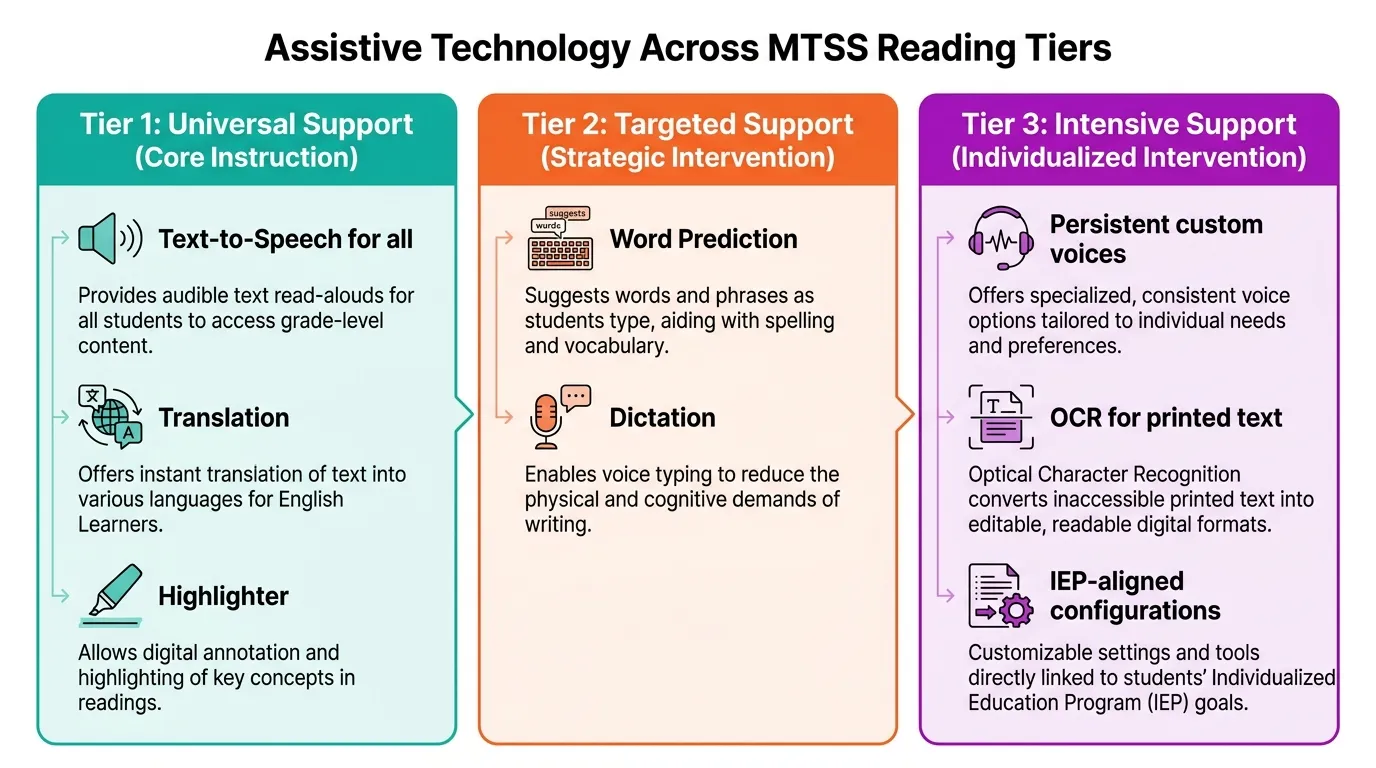
- Tier 1: Universal text-to-speech makes content accessible to every student during independent reading and content learning.
- Tier 2: Targeted use of dictation and word prediction helps students engage with content above their decoding level while skills build.
- Tier 3: Persistent custom configurations, OCR for printed materials, and structured vocabulary support meet the most intensive needs.
Research summarised by the National Institute of Child Health and Human Development shows that text-to-speech support increases comprehension for striving readers without reducing decoding gains.
How Mote Supports Reading Interventions Across Tiers
Mote was built to deliver reading support across the MTSS framework rather than as a Tier 3 accommodation only:
- Tier 1: Read Aloud, Translation, and Highlighter are available to every student in the classroom from day one.
- Tier 2: Text Prediction and Speech-to-Text scaffold reading-related writing tasks during small-group intervention.
- Tier 3: IEP-aligned configurations, persistent custom voices, and OCR for scanned and image-based texts meet the most intensive needs.
For deeper context on text-to-speech in reading instruction, see our Text-to-Speech pillar guide, or the full MTSS framework.
Match the Intervention to the Tier
Reading interventions fail most often because of mismatch, not bad science. Tier 1 fails when teachers spend it on small-group pull-out instead of strong core. Tier 2 fails when it becomes a permanent placement instead of a time-bound cycle. Tier 3 fails when it lacks fidelity or progress monitoring. The framework works when the intervention matches the tier and the tier matches the data. Pick your interventions, set your cycles, and trust the model.
.png)

.png)

.png)