



MTSS Implementation Plan: An 8-Step Roadmap for Schools in 2026
From building your team to monitoring fidelity, here is the step-by-step plan schools and districts use to launch or refine MTSS this academic year.




Schools and districts adopt MTSS implementation plans every year, but most stall in the first 90 days. The framework on paper looks straightforward; the reality is that MTSS implementation touches universal screening, instruction, intervention, behavioral data, family communication, and staff workload all at once. The plan below is the 8-step roadmap most successful schools follow when they take MTSS from policy document to working practice.
Why Most MTSS Implementations Stall
The two failure modes are predictable. The first is treating MTSS as a special education program, which puts the wrong staff at the table and slows everything down. The second is rolling out all eight steps simultaneously, which exhausts teachers and erodes trust. Successful implementation is sequenced and visible, not all-at-once.
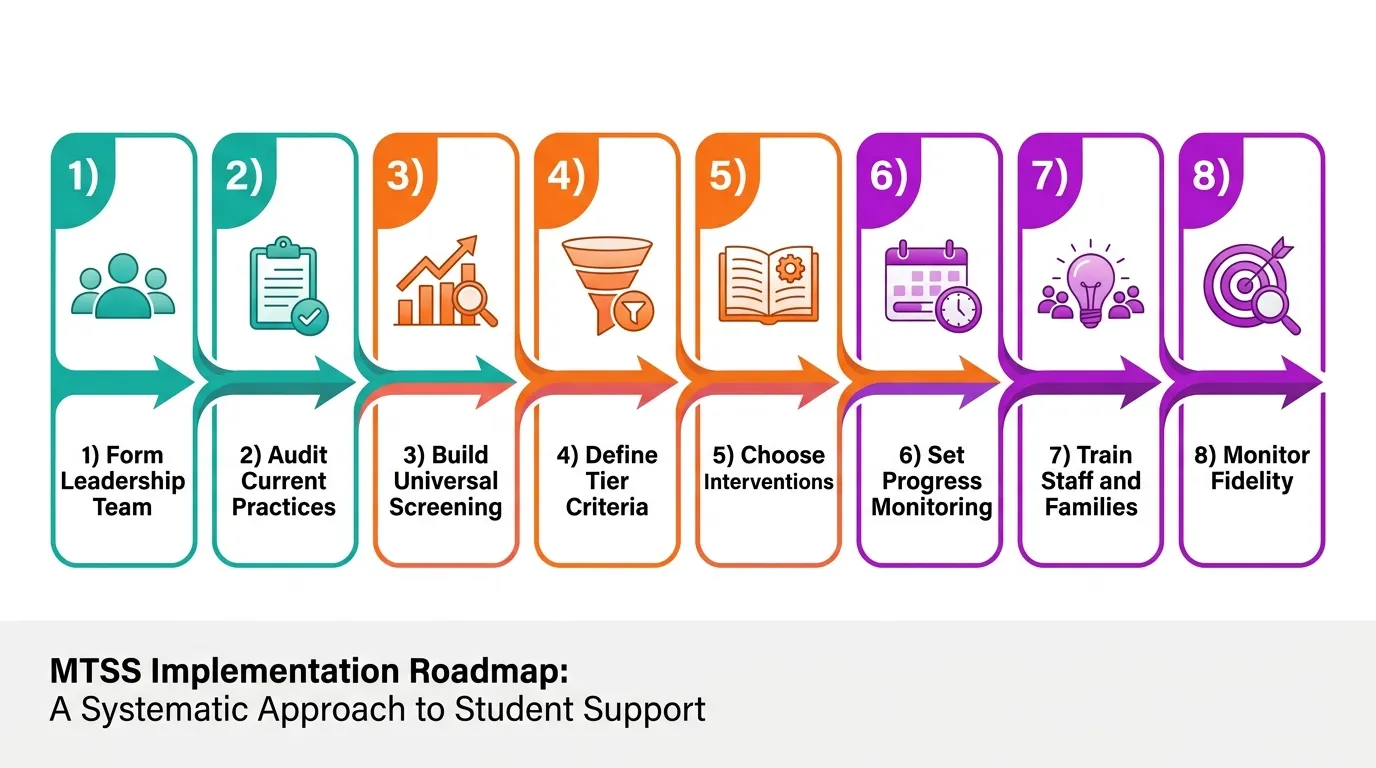
The 8-Step MTSS Implementation Plan
Plan for a full school year of staged rollout. Districts piloting MTSS in select schools can compress the cycle, but expect 18 to 24 months for district-wide rollout that holds up.
1. Form Your MTSS Leadership Team
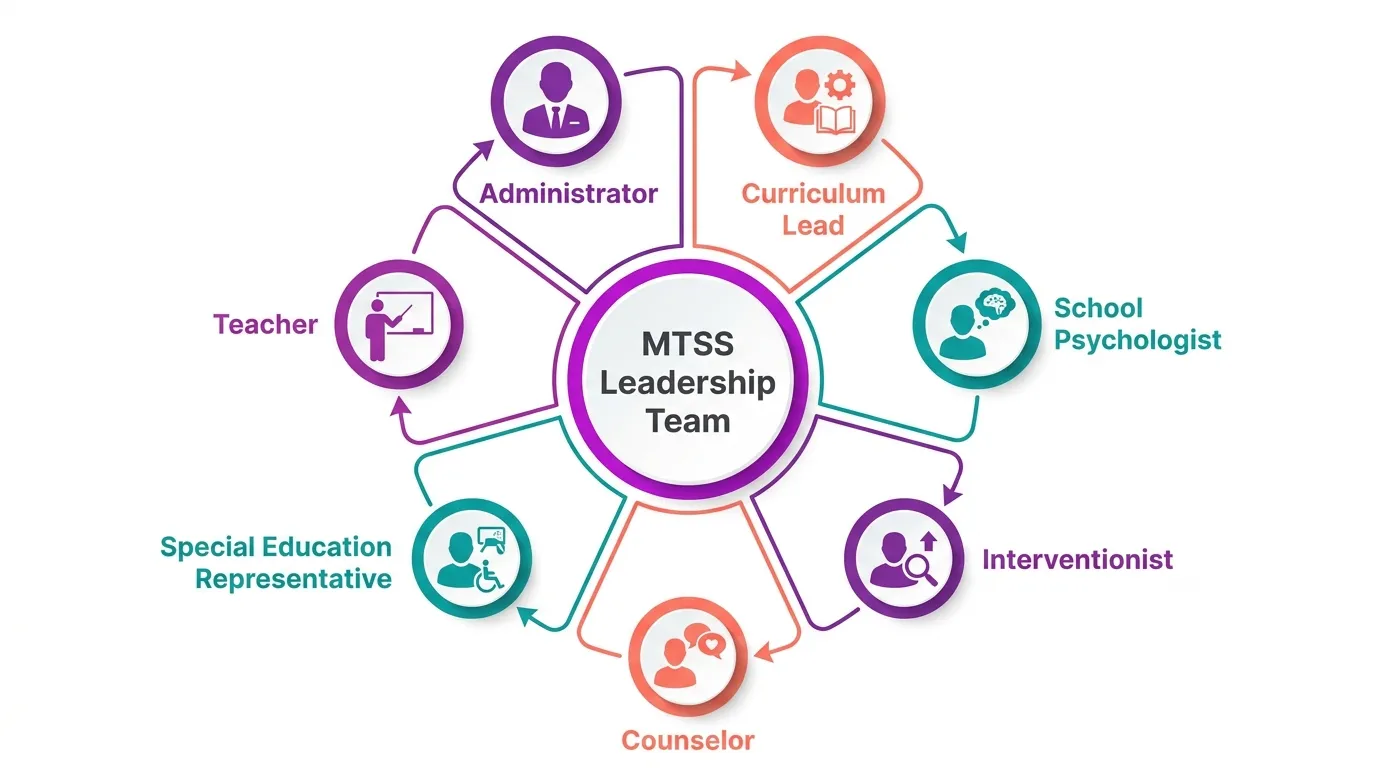
Build a 6 to 8 person leadership team that includes at least one administrator, a curriculum lead, a school psychologist, an interventionist, a counselor, a special education representative, and a teacher voice. The team meets every two weeks during launch and monthly thereafter. This team owns implementation; it is not a side project.
2. Audit Your Current Tiered Practices
Before adding anything new, document what your school already does at Tier 1, Tier 2, and Tier 3. Many schools find they have fragments of MTSS already running, just under different names. Our guide to MTSS tiers helps frame this audit. Identify gaps and duplications before designing new processes.
3. Build Your Universal Screening Process
Universal screening is the input that drives every tier decision. Pick valid screeners for academic, behavioral, and SEL domains, run them at least three times per year, and build a clean process for ingesting and reviewing the data. Without universal screening, MTSS is a feeling, not a system.
4. Define Tier Entry and Exit Criteria
Document exactly what triggers a move into Tier 2 (for example, scoring below the 25th percentile) and what marks a successful exit. Write these criteria into your team protocols before any student is placed. Pre-defined criteria are the difference between MTSS and a permanent intervention waiting list.
5. Choose Your Tier 2 and Tier 3 Interventions
Select evidence-based interventions for each tier and domain. Reference the What Works Clearinghouse for vetted options. Limit your menu to a small number of high-quality interventions you can deliver with fidelity, rather than a long list of options that overwhelm staff.
6. Set Up Progress Monitoring Cadence
Tier 2 students are typically progress-monitored every 1 to 2 weeks. Tier 3 students are monitored weekly. Calendar these data cycles in advance with clear ownership for who pulls the data, who reviews it, and when decisions are made. Without a calendar, monitoring drifts and decisions become reactive.
7. Train Staff and Communicate to Families
Roll out staff training in waves, starting with the leadership team, then grade-level leads, then the rest of staff. Communicate to families in plain language: what MTSS is, why their child may be in a tiered intervention, and what success looks like. Family confusion is the most common pushback, and it is solvable with clear messaging.
8. Monitor Fidelity and Iterate
Run quarterly fidelity checks asking three questions: are interventions being delivered as designed, is data being collected and reviewed on cadence, and are decisions being made by the team? Adjust the plan based on what fidelity data shows. Implementation is iterative; expect to refine through year two and three.
How Mote Supports MTSS Implementation
Mote sits inside the daily teacher workflow rather than as another platform to log into. That matters most during MTSS implementation, when staff are already absorbing new processes. Features map across the tiers as teachers and interventionists need them:
- Tier 1: Read Aloud, Translation, Screen Mask, and Highlighter are available to every student in the classroom from day one of the rollout.
- Tier 2: Text Prediction, Speech-to-Text, and voice feedback support small-group intervention without singling students out.
- Tier 3: IEP-aligned configurations, persistent custom voices, and admin-managed accommodations meet the most intensive needs without per-student manual setup.
For the full framework, see our MTSS pillar guide, or take our MTSS Tier Assessment Tool to see which features match your students' needs.
Implementation Beats Theory
The schools that succeed at MTSS are not the ones with the most polished plan document. They are the ones that get steps 1 through 4 working, even imperfectly, in the first semester, then build out steps 5 through 8 over the following year. Perfect plans never ship. Visible progress on a real schedule does. Pick your team, audit your practices, and start.
.png)
.png)